

By Tamanna Taban
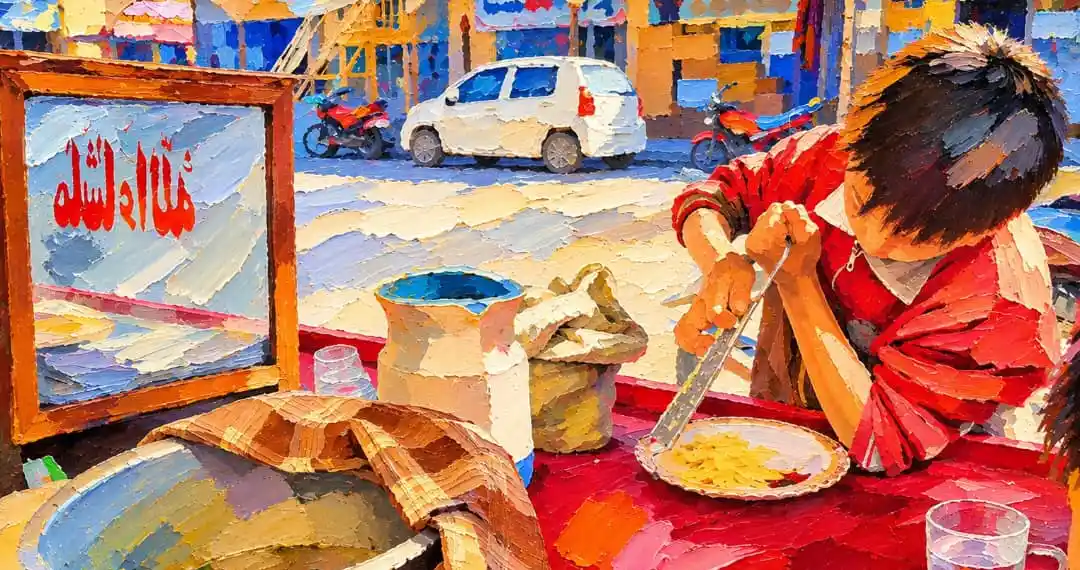
Early in the morning, at an hour when most children are still asleep, 12-year-old Ruhullah* sets out alone on the 40-minute walk to the restaurant where he works.
Once he gets there, he’ll work a 14-hour day serving food to customers to earn money so his family of six can eat, before walking home again.
“I come to work early in the morning and finish in the evening. I’m busy throughout the day, and when there are lots of customers at the restaurant, we’re running around without stopping,” he tells Rukhshana Media. “If my parents didn’t force me, I wouldn’t work here for even a single day.”
Ruhullah’s father used to work as a labourer on construction projects. But in recent years there hasn’t been much work in Bamiyan, a mountainous province in central Afghanistan and Salim*, 46, says he had no choice but to send his son to work instead of school.
Ruhullah works at least 14 hours a day, seven days a week, but makes only 1,000 afghanis (about £12) a month. “At least it’s enough to buy a jerrycan of cooking oil each month,” says his father.
But Ruhullah says he has to put up with regular scoldings from his employer. “They shout at us, telling us to hurry up and work faster. Sometimes they even yell at us and use really bad language.” The restaurant owner is unapologetic. The work is demanding, he says, adding that customers expect good service, and he’s not forcing anyone to work for him.
Rising poverty has left families with few options. More than half of Bamyan’s population of 516,000 people now needs humanitarian assistance, according to United Nations estimates. The Oxford Poverty and Human Development Initiative (OPHI) reports that 49.9 per cent of the province’s population experiences multidimensional poverty, meaning they’re deprived across several areas of life including education, healthcare, clean water, adequate housing and sufficient food.
One local community elder told Rukhshana Media that poverty in Bamiyan has increased since the Taliban took power. Provincial government departments are employing people from outside Bamiyan, he said, and some aid organisations have started doing the same. Rukhshana Media was unable to speak to the Taliban authorities in Bamiyan about this, but the province is predominantly populated by ethnic Hazaras, whom the Taliban have a history of discriminating against.
According to UNICEF, one in five children in Afghanistan now works. It’s not a new phenomenon – even before the Taliban takeover in 2021 child labour was a major problem in Afghanistan – but organisations working there say the situation has worsened significantly as levels of poverty have risen. Many men are struggling to find work, and most paid employment is off limits for women. In Bamiyan, you see more and more working children on the streets.
Most are boys, among them Zohur*, 13. He left school a year and a half ago to start working as a street vendor to help his father — a former security guard at a government institution who lost his job to a Taliban member when the group returned to power five years ago — to provide for the family.
“Some nights, we don’t even have bread to eat,” says Zohur, whose father now works as a security guard at a private school, but earns just 5,000 afghanis a month.
“Even if he can earn 50 afghanis a day, it’s a blessing for us,” says the older man. “I deprived him of the chance to go to school because we have no other choice.”
In another corner of Bamyan’s main market, 14-year-old Omid* has been running a small street stall for the past two years, selling socks and a few household items.
Omid wanted to study to fulfil his ambition to become a doctor. His mother Sahargul* made the difficult choice to take him out of school so that the family could survive.
“Education doesn’t put food on the table or give us water to drink,” she says. “That’s why I asked Omid to take out a small stall in the market, using money his father borrowed, and start working.”
“These days, surviving is more important than going to school.”
*Names have been changed for sources’ protection

