

By Tamana Taban
One spring day Mah Bibi’s three youngest sons were playing with an unusual object they had found in the ground when it exploded, killing them outright along with three friends.
The six children are among thousands who have been killed or severely injured by landmines and other explosive items left over from decades of conflict in Afghanistan.
Seven years on and the pain is still raw, but Mah Bibi* now draws on her family’s loss to save other young lives by spreading awareness of the hidden risks among her community in central Afghanistan.
Afghanistan is one of the most contaminated countries in the world. About 50 people are killed or injured from mines and explosive remnants of war every month, the third highest casualty rate after Myanmar and Syria. Nearly four in five victims are children.
Mah Bibi’s sons were playing with their friends beside a road when they spotted a piece of white metal. Curious, they struck it with a sickle.
On hearing the blast echo through the village, Mah Bibi rushed to the scene.
“All the children had fallen close together, and their blood had stained the ground red,” she told Rukhshana Media.
“Imagine losing three children, all torn to pieces, in a single day. It’s unbearable.”
The youngest was 5 years old, the oldest 12.
Afghanistan is littered with explosive items – a legacy from the Soviet-Afghanistan war in the 1980s, subsequent civil conflicts among rival factions, and fighting between the Taliban and former Afghan forces.
But international funding for mine action in Afghanistan has plunged in recent years, impacting clearance operations, risk education programmers and assistance for injured victims.
Children are particularly vulnerable because they often pick up objects while playing outdoors, tending animals or hunting for scrap metal to sell.
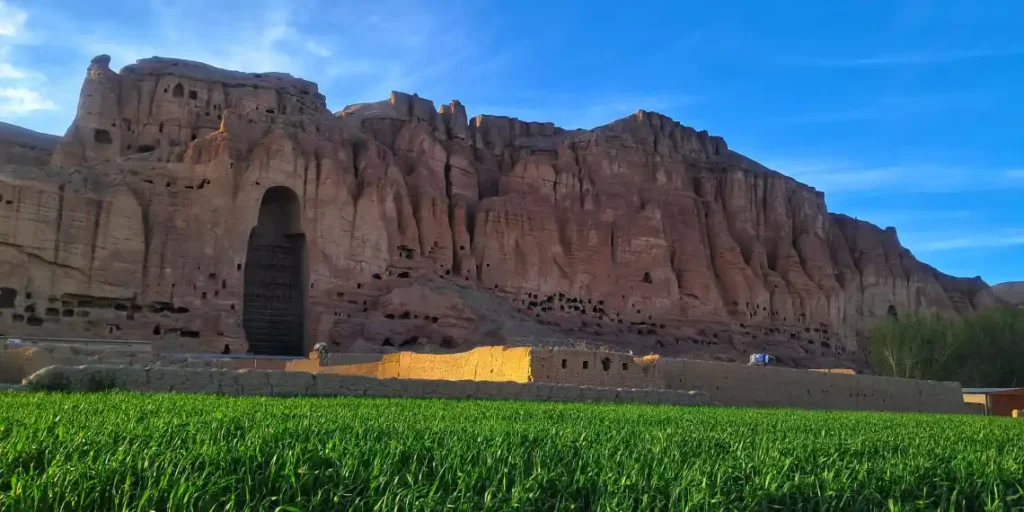
Mah Bibi, 52, who lives in a mountainous area in the west of Bamiyan Province, says no organisation had ever run an awareness campaign in her village before the tragedy on April 1, 2019.
As she grieved, she repeatedly shared her heartbreak with her neighbours, sobbing as she implored them to teach their own children never to touch unfamiliar objects they find in the ground.
Gradually, she realised that she had an important role to play in educating other women and children in her community and nearby villages.
“Although many years have passed since that day, my children’s faces are still before my eyes as if it were yesterday, and I can never forget them,” she said.
“I do not want any other mother to lose her child because of a landmine.”
DONORS CUT FUNDING
Mah Bibi uses women’s gatherings, family events, religious ceremonies and even weddings to spread her message.
Her voluntary mine education work is a family endeavour. One of her older children scours the internet for information and pictures to print out, while another helps her memorise the details.
She begins each talk with her own story before discussing the different types of deadly ordnance that could lie buried in the ground and sharing photos with her audience.
More than 1,000 square kilometres of land are still known to be contaminated in Afghanistan, preventing people from farming, collecting wood and water and accessing healthcare and schools. An estimated 3 million people live within a kilometre of this land.
But funding for mine action work in Afghanistan fell to $24 million last year, down from $38.3 million in 2024, according to an expert citing figures from the country’s de facto authorities.
The United States, once one of the largest donors, cut all funding for mine action in Afghanistan last year when President Donald Trump’s administration slashed foreign assistance. Other donors have also scaled back.
The cuts continue to have a severe impact – the number of mine action personnel has more than halved since March falling from 1,300 to under 600. This is down from 15,000 personnel in 2011.
Mohammad Ali Momeni, a community activist in Bamiyan, said voluntary initiatives like Mah Bibi’s were crucial for protecting people across the country.
Today, Mah Bibi is seen as a local hero in her community.
She believes her mine awareness work has saved many lives. But it has also helped her alleviate her suffering.
“This work has healed and eased a large part of my grief,” she said. “Without it, I truly don’t know where this immense pain would have taken my life.”
*Name changed for security reasons.

