

By Raha Azad,Azada Tran and Ghazaal Mohammadi
When Azizgul went into labour at her home in northern Afghanistan her family put her on a donkey for the three-hour journey to the nearest clinic, but she never made it home again.
Azizgul* was bleeding heavily when she arrived, but the clinic lacked the staff and equipment to help. By the time she reached hospital, she and her unborn baby had died.
Afghanistan has one of the highest maternal mortality rates in the world, with one woman dying every two hours in pregnancy or childbirth.
Data is lacking, but health experts fear the crisis is worsening under Taliban rule.
“It’s very distressing,” said one hospital doctor in Badakhshan in northeast Afghanistan. “Maternal and neonatal deaths … have increased over the past year across the province.”
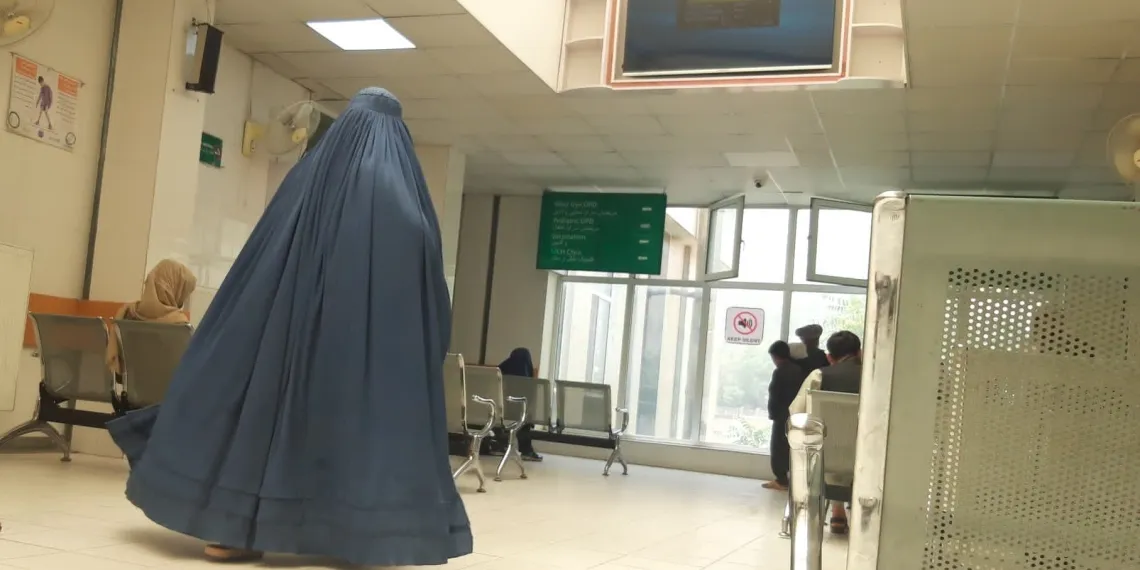
Pregnant women and health workers who spoke to Rukhshana Media painted a picture of a rapidly deteriorating health service, hamstrung by a lack of staff, equipment and medication, and the closure of hundreds of clinics.
Several women said they had lost their babies because of delays at understaffed hospitals. They described how three or four women were forced to share single beds, while others were left writhing in pain on corridor floors.
Factors behind Afghanistan’s worsening maternal healthcare include a dramatic drop in international aid, the Taliban’s ban on women’s education and employment, and an exodus of medical staff who have fled into exile.
Deepening poverty has also fuelled malnutrition and child marriage, which both heighten the dangers of pregnancy and childbirth.
HOSPITALS OVERFLOWING
The maternity unit at Faizabad Provincial Hospital in Badakhshan sees up to 100 women a day, but has only one obstetrician on duty at a time dealing with back-to-back emergencies.
Masouma, 24, said she was in agony and needed urgent surgery when she arrived on September 28, but the ward was crammed and there were eight patients in front of her.
By the time she had a Caesarean her baby’s heartbeat had stopped; he had been strangled by the umbilical cord as she waited to be seen.
Masouma said she was not the only mother to lose her baby that night.
Another woman at the hospital said staff told her she needed a Caesarean but then ignored her for days while they prioritised patients with Taliban connections. Her baby died shortly after birth.
A medical source familiar with the hospital blamed problems on corruption and mismanagement, adding that a local organisation with ties to senior Taliban figures had taken over running the hospital from an international organisation about a year ago.
Rukhshana Media could not contact the Taliban or the local organisation.
The source, who requested anonymity for their safety, said about 90 percent of medical equipment, including anaesthetic machines, sterilisation equipment, surgical instruments and oxygen equipment, was broken or not maintained.
A significant number of staff had also left, including two obstetricians, the head of midwifery and senior nurses. Some had gone to private hospitals where pay is higher.
The source said some emergency cases now had to be sent to Kunduz, a city 200 km (120 miles) west of Faizabad.
The picture is similar elsewhere.
In Sar-e Pol province, a midwife at the clinic which turned Azizgul away said they had lost half their staff and the centre’s specialist had left Afghanistan.
But even if Azizgul had made it to hospital, she might not have survived.
A health worker at Sar-e Pol Provincial Hospital said neither of its two obstetricians were on site in the afternoon or overnight.
One woman told Rukhshana Media she lost her baby because there was no specialist when she arrived mid-afternoon. Another recently died from miscarriage complications after arriving at night.
MIDWIFE TRAINING BAN
Although most international assistance for Afghanistan was frozen after the Taliban seized power in 2021, donors led by the United States continued to support critical services like health.
But in 2025, the United States halted humanitarian funding for Afghanistan as it slashed its foreign aid budget. Other donors have also cut back.
About 600 health facilities across the country have since shut or suspended services, according to the World Health Organization.
The U.S. non-profit Refugees International said in a report in August that the funding cuts had contributed to deaths.
Hospital data in the western province of Herat showed the maternal mortality ratio was almost five times higher in the first half of 2026 than in 2025, according to the study.
In Nangarhar province in the east, it said the neonatal mortality rate across six hospitals was nearly 60 percent higher in 2025 than 2024.
Researchers also said that more than two-thirds of the 383 midwives they surveyed across the country had reported losing their jobs after the U.S. cuts.
But funding is not the only problem. In 2024, the Taliban banned women from training as doctors, midwives and nurses.
The move has effectively halted the supply of future female health professionals. The potential impact is particularly catastrophic in a country where Taliban rules and cultural norms often prevent women seeing male doctors.
Human rights experts say the ban will lead to unnecessary suffering, illness and deaths.
Problems are already apparent.
Masouma said one of the midwives carrying out her Caesarean berated her colleague for not knowing where to make the incision.
Alia, 31, who worked as a nurse at Faizabad Provincial Hospital five years ago, said she could scarcely believe how bad things had got when she recently attended with her third pregnancy.
She said the admissions room had only one qualified midwife and a few inexperienced volunteers. Patients’ relatives were falling at the volunteers’ feet in desperation, begging for help.
Even basic supplies such as plasters, bandages and gauze pads were unavailable.
“The hospital used to have good facilities, skilled doctors and sufficient staff,” Alia said.
“But now, poor mothers scream in pain in corridors, and no one cares whether they live or die.”
* We have used pseudonyms for all the women interviewed to protect their identities.

