

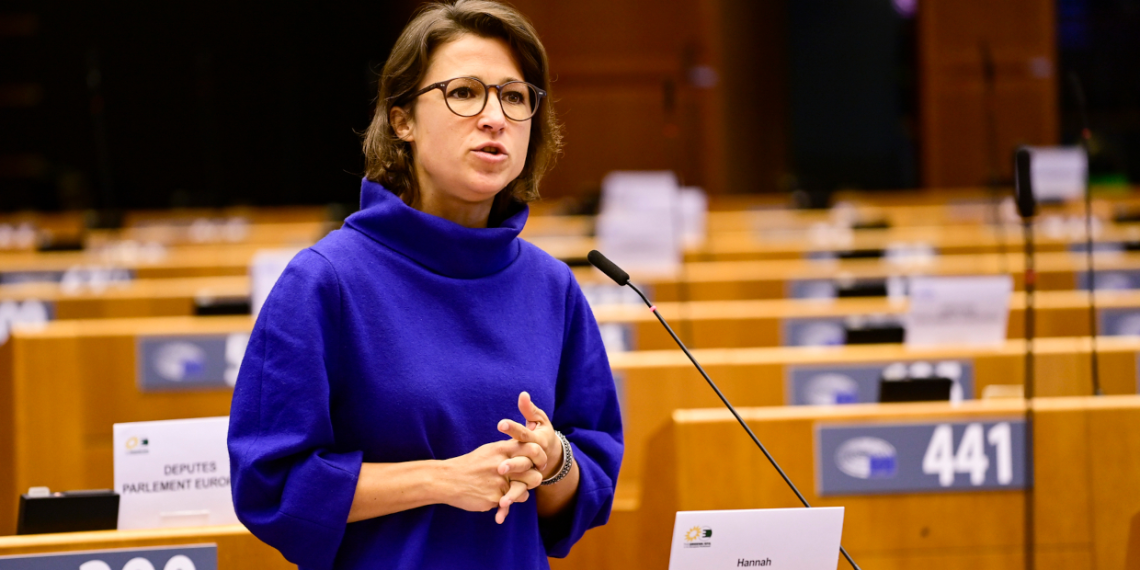
Hannah Neumann is a Member of the European Parliament (MEP) for Germany’s Green Party who focuses on foreign policy and human rights and has used her position to advocate strongly for Afghan women and girls since the Taliban’s return to power. We spoke to her to mark five years of Taliban rule. Here are her answers to our questions, lightly edited for length and clarity.
1. It has been almost five years since the Taliban retook power. What worries you most about their record so far?
The Taliban remained true to their ideology. That is dramatic for the people in Afghanistan, but frankly said, no surprise. What worries me even more today is that parts of the international community are slowly beginning to adapt to this reality. Over the past five years, the Taliban have systematically dismantled the rights, freedoms and public presence of women and girls. This is the very foundation of their system of rule. At the same time, international attention has shifted. We hear more about migration, security and diplomatic engagement, while Afghan women and human rights are becoming an afterthought. The greatest danger today is not only what the Taliban are doing. The world begins to treat their oppression as the new normal. That is precisely what we must resist.
2. You have said that the Taliban have established gender apartheid in Afghanistan. If so, what is your argument for this?
Because this is far more than discrimination. We are witnessing the systematic exclusion of women and girls from almost every aspect of public life simply because they are women. Girls are denied secondary and higher education. Women are excluded from most professions, from political participation, from many public spaces. Even access to healthcare without a male guardian. Those who resist face intimidation, punishment and violence.
These are not isolated measures. It is a coherent system designed to erase women from public life. That is why many Afghan women themselves describe their reality as gender apartheid. I believe we should listen to them. Our political and legal language should reflect the reality they are living.
3. Why did you think the world has been slow to recognise gender apartheid in Afghanistan?
International law often moves more slowly than political reality. There is also hesitation because gender apartheid is not yet recognised as a distinct crime under international law. Some governments fear opening broader legal debates or creating new precedents. But legal uncertainty cannot become an excuse for political inaction. Apartheid itself became a recognised international crime because the international community acknowledged that existing legal concepts were not enough.
4. What paths exist for recognising gender apartheid in Afghanistan?
Recognition can happen on several levels simultaneously. States can recognise gender apartheid politically through parliamentary resolutions and government declarations. International organisations can incorporate the concept into their work and reporting. Most importantly, negotiations on a new international treaty on crimes against humanity offer an opportunity to explicitly include gender apartheid in international law. Recognition is only the first step. It should shape asylum policy, sanctions, diplomatic engagement and accountability efforts. Otherwise, recognition risks becoming symbolic rather than meaningful.
5. Is there a plan for the European Union to recognise gender apartheid in Afghanistan?
The European Parliament has consistently taken a strong position in support of recognising gender apartheid and defending the rights of Afghan women. Across the EU institutions there is growing awareness that the situation in Afghanistan is unprecedented in its systematic exclusion of women and girls. At the same time, formal recognition remains a work in progress. I believe the European Union should lead on this issue. Europe has long presented itself as a global defender of women’s rights. Supporting the recognition of gender apartheid is therefore not only about Afghanistan. It is also about the credibility of Europe’s own values.
6. How does the European Union view the Taliban more broadly?
The European Union does not recognise the Taliban as the legitimate government of Afghanistan. Our engagement has always been guided by clear conditions. Shortly after the Taliban takeover, the EU established five benchmarks covering human rights, women’s rights, inclusive governance, humanitarian access and preventing Afghanistan from becoming a safe haven for terrorism. Necessary operational contacts may sometimes be unavoidable, particularly to deliver humanitarian assistance. But engagement must never become political normalisation. Every contact with the Taliban carries political meaning. That is why maintaining clear red lines remains essential.
The European Union must also recognise that protection does not end when someone reaches Europe. Women who fled Taliban persecution should never again become dependent on Taliban controlled institutions to renew a passport, register a child or obtain basic documents. Otherwise, we risk allowing them influence to extend beyond Afghanistan’s borders.
8. What is your assessment of international efforts to hold the Taliban accountable? Have they been sufficiently coordinated and effective?
No. The international community has been remarkably united in condemning Taliban policies. It has been far less united in translating that condemnation into sustained political leverage. There have been important initiatives, from UN mechanisms to accountability efforts before international courts, but overall the pressure has been fragmented and often reactive. Meanwhile, the Taliban have shown that they are prepared to absorb diplomatic criticism if it comes without meaningful consequences. Accountability requires persistence, coordination and political consistency. Not occasional expressions of concern.
9. How can the Taliban be held accountable on women’s rights and human rights issues?
There is no single instrument. Accountability means combining legal, diplomatic and political pressure. That includes supporting ongoing international accountability mechanisms, targeted sanctions against those responsible for serious abuses, protecting independent documentation efforts and ensuring that human rights remain central to every international engagement with the Taliban. Equally important is refusing to reward systematic repression with political legitimacy. The absence of recognition should not be seen as symbolic. It is part of maintaining international pressure. Accountability is not one action. It is the cumulative effect of many consistent political, legal and diplomatic choices.
10. How do you view Afghan women’s struggle against the Taliban?
I consider it one of the most courageous human rights movements in the world today. Despite extraordinary risks, Afghan women continue to organise, document abuses, educate girls, support one another and refuse to disappear. Resistance does not always look like mass demonstrations. Sometimes resistance means teaching girls in secret. Sometimes it means documenting abuses. Sometimes it means simply refusing to disappear. Afghan women are not passive victims. They are political actors shaping the future of Afghanistan
12. How can the European Union support Afghan women’s resistance?
First, by listening. Second, by protecting. Third, by creating political space. The EU should continue supporting Afghan women-led organisations inside and outside Afghanistan, strengthen educational opportunities, facilitate safe pathways for those at risk and ensure that Afghan women participate meaningfully in international discussions about their country’s future. Protection does not end when Afghan women cross a border. Europe has recognised that Afghan women are persecuted by the Taliban. That recognition must have practical consequences. Women who escaped Taliban rule should never be placed in a position where they once again depend on Taliban controlled institutions to renew documents, register their children or resolve essential administrative matters. Otherwise, we protect people from the Taliban geographically, while allowing the Taliban’s power to follow them politically.
13. How do you see the future of Afghan women if the current situation continues?
The current trajectory is deeply alarming. Every year that girls remain out of school and women remain excluded from public life causes lasting damage. Not only to individual lives, but to Afghanistan’s future as a whole. Yet I remain hopeful because authoritarian systems cannot erase human dignity. The courage shown by Afghan women over the past five years demonstrates extraordinary resilience. History reminds us that systems built on repression often appear permanent, until they are not.

