

By Arezo Rahimi
On the morning of August 15, Mina Rezaee‘s cafe was open, but unlike any other day over the past four years, it was empty. The neighbouring shops and restaurants were closing in a hurry, and people were chaotically running about. “The Taliban entered the city,” Rezaee heard someone shouting in the ruckus.
Shocked and terrified, the 32-year-old closed Simple Cafe and sent her employees home.
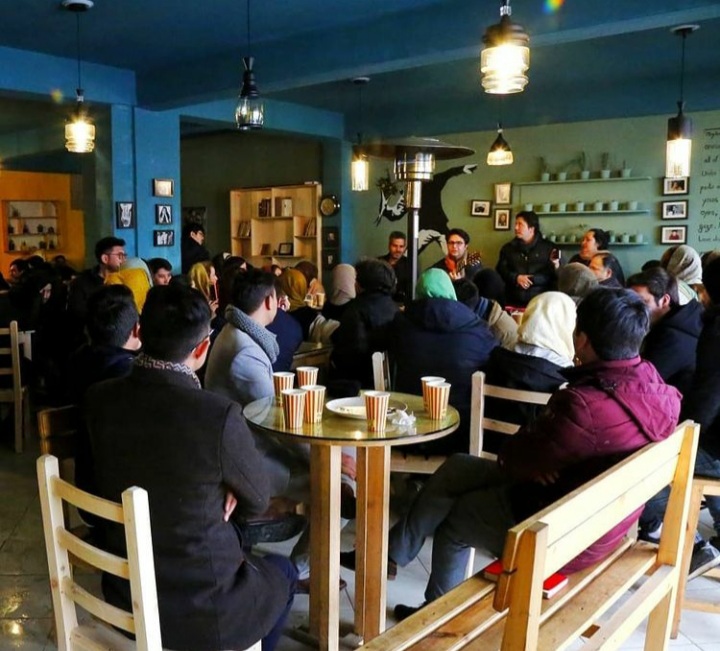
For Rezaee, one of the few female cafe owners in Afghanistan, Simple wasn’t only a cafe. “It was my hope, my resistance and my freedom,” she told Rukshana Media from Rouen in France, where she lives after being evacuated by the French government in late August. “I wanted Simple to be a place where women feel comfortable, where they can feel freedom.”
Rezaee set up Simple Cafe in January 2018 with less than a thousand US dollars. The cafe’s green walls were decorated with portraits of Simone De Beauvoir and Frida Kahlo, and served Afghan traditional foods such as Ashak, Manto, Ash, which were often cooked by her mother. Music was an integral part of cafe life, and young women and men would sometimes gather to listen to live acts. On Cafe’s anniversary, in January 2020, Afghan pop singer Shekib Mosadeq performed live. The cafe was a place for artists where they could perform and put their work up for sale.
“I am happy because I proved to … my father that a woman can be successful just like a man. She can run a business and be a breadwinner. Convincing my family took a while but I am happy that my struggles paid off, and I am part of the change in my society,” Rezaee wrote on her Facebook page in February 2019, when she moved Simple Cafe to a bigger place as she was often at full capacity, having to turn customers away. “I am happy to create a small group and a calm space in this war-torn city to drink tea and coffee and talk and laugh. These small joys make life bearable in Kabul,” her Facebook page reads.
In recent years, cafes serving coffee and cakes became part of the urban fabric in the Afghan capital, providing a much-needed space where its youths could gather. Kabul’s cafe culture became emblematic of a transformed city full of hopeful people rebuilding their country. With the Taliban back in power, it has all but disappeared.
Rezaee’s cafe, once her hope for the future, is closed for now as she tries to recover from the pain and trauma of losing everything she worked for over years in “half a day.”
Mohammad Kazemi, the owner of Negar Cafe in Kabul, had an all-female staff working as waiters and chefs. After the fall of Kabul, he tried to keep his business running, but when the Taliban showed up on the cafe’s doorstep, he decided to close his $25,000 dollar business investment.
A week after the Taliban entered Kabul, they set up a checkpoint in front of his cafe, searching pedestrians’ phones. Later, he says the Taliban entered his cafe, threatened young women and men who sat together, and forced them to leave.
“We will give you a smile and will create calm,” reads one of Negar Cafe’s walls. “Now, there is no smile and there is no calm,” Kazemi said in a phone interview.
In the Afghan capital where the economic and humanitarian crises are taking a toll on people’s lives and livelihoods and where secondary schools and public universities are closed to young women, keeping a cafe business running is a huge challenge.
“Our customers decreased by 95%, especially among young people, particularly women. We barely make enough to pay the grocery bill,” said Azizullah Gulzada, the owner of CupCake Cafe, located a few hundred meters away from Simple Cafe.
For Gulzada, who also established his first cafe in 2018, business was so good that he opened the second branch of CupCake in downtown Kabul, a week before the Taliban came. “In both branches, women were working as chefs and waiters, but with the Taliban’s restriction, they can’t come to work,” Gulzada told Rukhshana Media, adding only one of the female chefs is still working in the cafe’s kitchen.
“It is hard to fight with your family, society and at the workplace for years to gain some rights and reach a position, but lose it in the blink of an eye,” Rezaee said.
“These days, I feel I have lost [the resistance]. I have lost everything in half a day. I could only save my flesh,” she wrote on her Facebook page a month after the Taliban returned to power. “Yes, I am broken. Now I wonder how to stand up and how to rebuild. How should I restart from scratch at 32?”

