

By Azada Taran
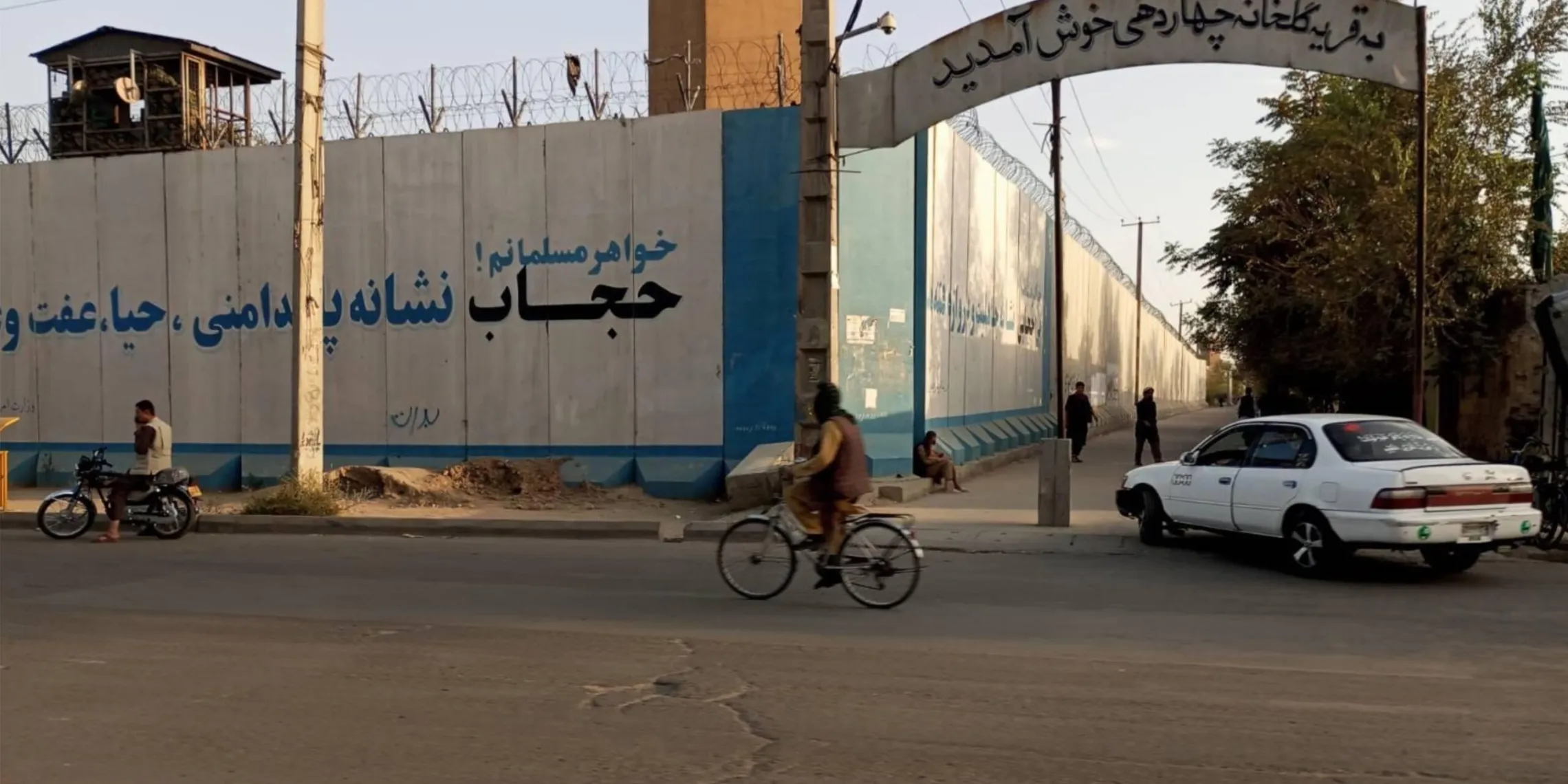
At the entrance to the Malalai Hospital for women and children in Kabul, a message painted on a wall reads: “Sister, please observe the hijab.”
Not far away, on the wall of the building that housed Afghanistan’s women’s ministry before it was disbanded by the Taliban are the words: “Failure to wear the hijab is a sign of ignorance and a gateway to temptation and moral corruption.” The building is now home to the Taliban’s Ministry for the Promotion of Virtue and Prevention of Vice, the government department responsible for issuing more than 100 decrees restricting women’s rights.
These are among the countless slogans daubed on the walls of government and other high-profile buildings around Kabul that promote the Taliban’s restrictions on women’s freedoms. In the Afghan capital, even the walls are now telling women what to do.
Some of the messaging seems almost designed to provoke. Written on the wall of Afghan broadcaster Ariana Television’s Kabul headquarters are the words, “sister we have pledged our blood to protect your hijab.”
Before the Taliban returned to power in 2021, Ariana Television was a symbol of freedom of expression in Afghanistan. It employed many women, who worked without restrictions on what they wore.
“These messages have been put up almost everywhere in the city,” says Salima*, 28, who lives with her husband of two years in Kabul’s Sixth District. Both her husband and her elder brother are employed by the Taliban in different branches of the de-facto administration, and both have internalised the messages being constantly fed to them, she says.
“At first, my husband had a reasonable attitude, but gradually his thinking became more Taliban-like and extremist,” she says. “Now he won’t let me leave the house without gloves and a hijab. Sometimes, when I stand up to him, he punches and kicks me. Their minds have been completely brainwashed by the extremist teachings of the vice and virtue authorities.”
The Taliban also introduced punishments for violating the restrictions, including against men they deemed to be responsible for their female relatives. Female government employees who fail to comply with the decree can be dismissed, while male employees whose wives, daughters and sisters violate the restrictions can be suspended from their jobs.
Afghan men who spoke to Rukhshana Media said the slogans displayed around the capital reinforced their fears of flouting Taliban edicts, even if they disagreed with them. “Men, too, have been forced by fear to keep their wives and daughters confined at home and not allow them to go out very often,” said Mohammad*, a shopkeeper with three daughters aged six, 16 and 24.
“For four years, we have been told every single day to make sure the women in our families observe the hijab,” said Ahmad Wali*, who works at a private university in Kabul. “It definitely has an impact.”
The walls of the Afghan capital have long been coopted for political messaging. After the Taliban swept back into power in Kabul in 2021, there were multiple reports of them painting over murals – including one memorialising a Japanese aid worker – with victory slogans and paintings of the Taliban flag.
Today, many of the slogans focus on the draconian restrictions on women’s dress that were introduced by Taliban leader Hibatullah Akhundzada, who issued a decree in 2022 requiring women to cover their entire faces in public, leaving only their eyes visible and advising women to remain at home unless they had an important reason to go out.
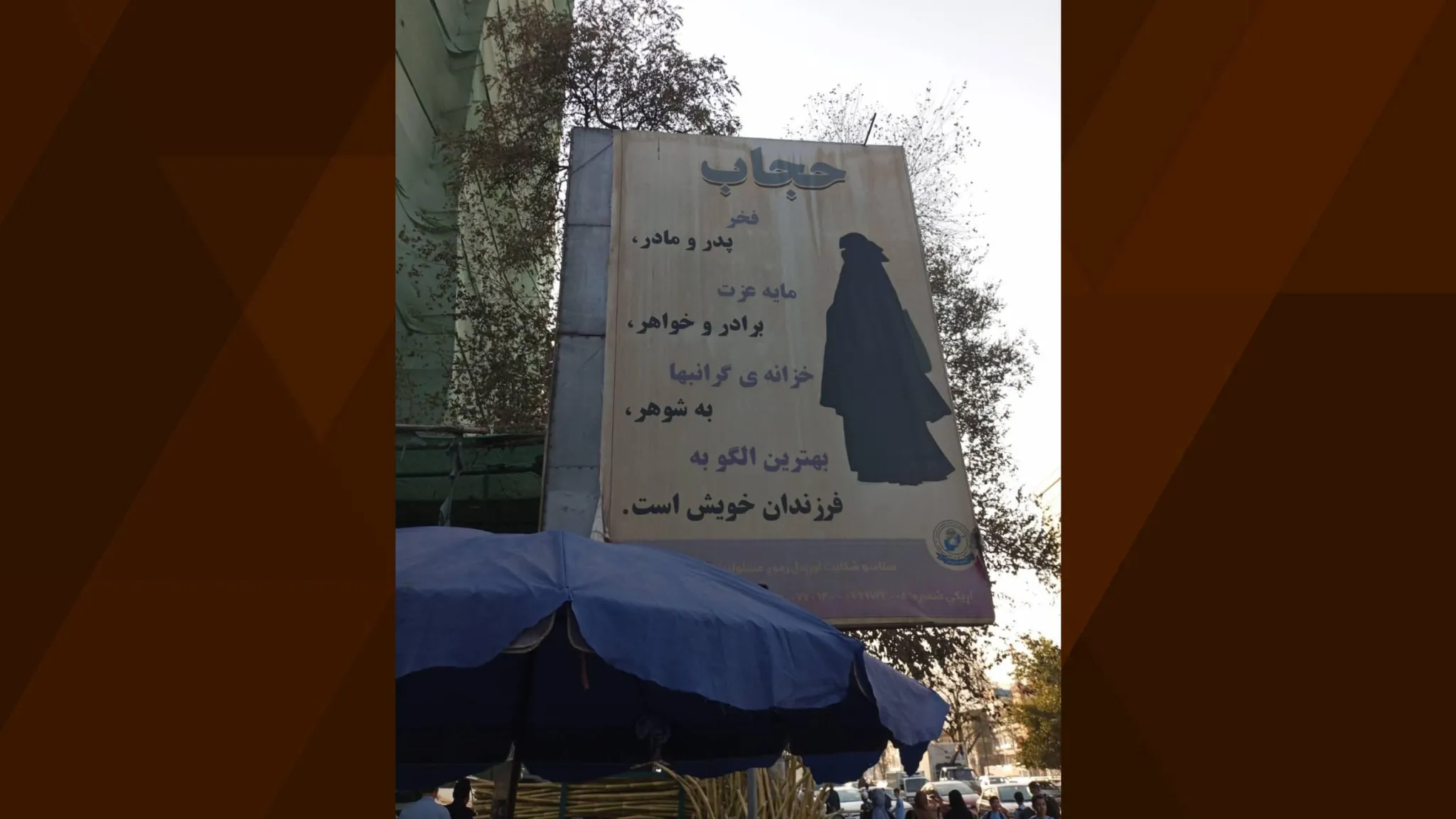
Image: Rukhshana Media – “Hijab is a father’s pride, a family’s honor, a precious gift to her husband, and a beautiful example for her children.“
For women in Kabul, these messages are impossible to avoid – and that’s the point. They’ve transformed the appearance of a city whose walls were once painted with colourful murals or with slogans calling for freedom – popular art, rather than political propaganda.
They exist as a daily reminder of rising pressure on women, who the UN last year said face “an unprecedented spectrum of violence, from the erosion of their rights and mobility to the daily threat of physical, psychological and economic harm”.
Karima Azam, an Afghan doctor who now runs a group called the Women’s Protest Movement of Northern Afghanistan from exile in Germany, fears they will have a corrosive effect on social norms. “These slogans must be examined within the broader context of restrictive policies against women because their real impact becomes apparent when a simple message on a wall is accompanied by a range of legal, social and cultural restrictions,” she says. “Over time, this kind of propaganda also influences men and teenage boys within families.”
Shahzad*, 36, a psychology graduate in Kabul, described the wall slogans as “psychological warfare”. “The emphasis on the hijab, based on the Taliban’s particular interpretation of religion, has gone beyond a religious instruction. It has become a tool for exercising social control and restricting women’s freedoms and their participation in society,” he said.
It’s hard to say precisely what the impact of the murals are. But there is no doubt they feed into a broader culture of misogyny that research published last year by the Women and Children Research and Advocacy Network found was both a cause and a consequence of narrowing freedoms for women.
For Salima, the impact is clear. “When I read these messages and slogans, I become extremely upset,” she says. “To tell the truth, I feel hopeless.”
Note: Names marked with an asterisk (*) are pseudonyms. Some details have been changed or omitted to protect the identities of those interviewed.

