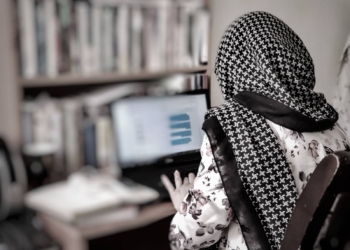
The struggle for women’s rights is profoundly urgent in Afghanistan. Being a woman is a clear basis for outright discrimination and inequality enforced throughout the country. But, much to the Taliban’s dismay, it is also fueling a justice-seeking force that refuses to accept the status quo and is never going to back down on advocating for human equality.
The Afghan people’s desire for justice and human equality is under great strain. The denial of women’s human identity has never been more blatant in the modern era. The discrimination that women have endured indirectly and implicitly throughout history is now explicitly codified in the socio-cultural system and political structure.
It is essential to understand the social-historical factors contributing to this situation, but even more critical is the fact that women are now explicitly told they do not have equal human rights to men. According to Taliban ideology, a human society consists primarily of men, with women living a shadowy, subservient existence. Women’s place in society is only important where valued by men, Indeed, without men, a woman’s life in Afghanistan lacks significance. This is the way the Taliban wants Afghans to live.
This situation now calls on women worldwide, particularly the Afghan sisterhood, to fight. Women face two choices: either they accept that women are not human and therefore lack the same rights as men, or they resist and stand up against this situation.
These dire circumstances are both stark and ripe for transformation. If women and other justice-seeking forces can overcome the current situation, the struggle for justice and the affirmation of women’s human identity will fundamentally change. This achievement would usher in a new phase for the women’s equality movement, defeating misogyny in its most potent stronghold.
Nearly two years on since the Taliban took control as the de facto authority in Afghanistan and with more than 40 decrees repressing and restricting women’s lives, it is clear that the struggle of Afghan women is an enduring and challenging battle. Internally, this struggle contends with repression, violence, and coercion from the Taliban, but also from within families, fathers, brothers and even ourselves, who fear for our lives. While externally, it is undermined by fragmentation and discord.
Given these complexities and the collapse of institutions that once provided a platform for women’s action and resistance, it is unrealistic to expect a widespread female rebellion or resistance from within Afghanistan. However, the situation is different for activists who have left the country. These individuals have gradually settled in host countries, and now they can initiate more coherent and coordinated actions.
What steps should they take?
First – coordination. Over the last 20 months, significant activities have occurred abroad, but inconsistency and dispersion have hindered the creation of a strong backing for change. With a clearer understanding of the international community’s capacities, opportunities, and limitations, it is time for women’s activities to evolve from immediate, spontaneous, and unplanned to coordinated, codified, and targeted programs.
Second – networking. Experience and current realities demonstrate that it is not feasible to coordinate activities by creating just one or two institutions. If there is genuine commitment to human work and struggle, institutional diversity can not only facilitate coordination but also enhance its capacity and effectiveness. So, it is important for women to act within different institutions, but ultimately, a coordinating mechanism for these institutions is needed.
How to coordinate? The most effective method of coordination is through networking. In today’s complex and ever-fluid society, networks play a vital role in coordinating departments, organizations, businesses, and political movements. As networks are decentralized and operate horizontally, they can accommodate various institutional, structural, and organizational diversities. Networks are inherently fluid and flexible, adapting to population, needs, and capacities.
Networks all the independence and autonomy of the institutions and organizations they serve, while connecting them to broader structures, linking localized institutional actions to a global network of activities. Given the long and challenging road of women’s struggles, the need to create a global network for women’s struggles is more pressing than ever. Establishing such a network can channel the disparate and uncoordinated energies of justice-seeking individuals in a unified direction, thereby elevating the struggle to a more effective stage.
The conversation has begun. Let’s build the network.